
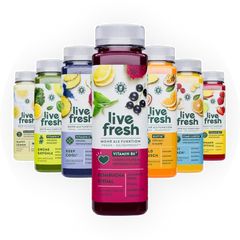
- 7 juices + 3 shots per day, cold-pressed¹









-
Vegetable broth base - organic & vegan
FromRegular price CHF 4.99Regular priceUnit price CHF 3.70 per 100g -
 🔖 Du sparst 17%
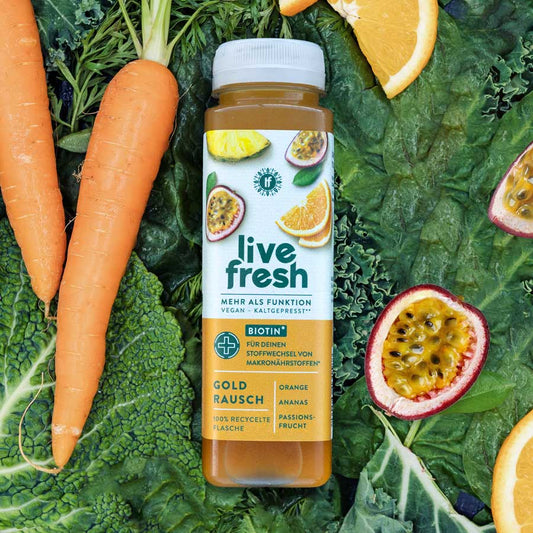
Gold Rausch - Juice - 250ml
FromRegular price CHF 17.42Regular priceUnit price CHF 11.61 per lCHF 20.99Sale price CHF 17.42 -
 🔖 Du sparst 20%
Fruit & green tea with vegetable broth
Regular price CHF 20.88Regular priceUnit price perCHF 26.11Sale price CHF 20.88


Carrots: The Colorful Superfood for Your Everyday Enjoyment
Carrots are among the most versatile vegetables of all: From classic orange to deep black to white varieties and their original wild form, they offer a colorful variety.
At the same time, they provide beta-carotene, dietary fiber, and essential minerals—natural components of a balanced diet. At LiveFresh, we bring carrots to your plate in bowls, juices, broths, and snacks—simple, delicious, and versatile enough to fit into your everyday life.
What Is a Carrot? Origin, Botany, & Variety
The carrot is one of the world’s most popular root vegetables—and it’s no wonder: it’s flavorful, versatile, and works just as well in hot dishes as it does in snacks or juices. Botanically, it belongs to the umbellifer family and is closely related to celery and parsley.
From classic orange to purple, white, or “wild,” carrots bring a true variety of colors to your plate and open up countless culinary possibilities.
LiveFresh uses them in vibrant juices, broths, and modern bowls—perfect for your health-conscious lifestyle.
Carrot, Möhre & Co.: What’s the Difference?
Whether you call them carrots, Möhren, Rüebli, or Gelbe Rübe, all these terms describe the same vegetable. They vary by region but have the same flavor.
Only the wild carrot is different: smaller, lighter in color, and more bitter—but especially aromatic.
Colorful Varieties for Modern Cooking
- Black carrot: bold flavor, rich in anthocyanins, ideal for salads and bowls.
- White carrot: mild, tender, perfect for light dishes and as a raw vegetable.
- Orange carrots: classically sweet and aromatic, a versatile staple in cooking and juices.
- Wild carrot: spicy, herbaceous flavor, exciting in salads and smoothies.
Nutrients & Calories: What’s in a Carrot
Carrots add color, flavor, and natural nutrients. They’re low in calories and a perfect fit for an active lifestyle—whether at the office, college, for meal prep, or as a snack for kids.
Nutritional values per 100 g (typical):
- 33–40 kcal
- 6.8 g carbohydrates, of which approx. 5 g are natural sugars
- 3.1 g fiber
- ~8 mg beta-carotene (precursor to vitamin A)
- 320 mg potassium
- approx. 12 mg magnesium
Documented in the Federal Food Code.
Why this is important for everyday life:
- According to the German Nutrition Society (DGE), dietary fiber is part of a balanced diet.
- Potassium supports normal muscle function (EFSA).
- Vitamin A precursors contribute to the maintenance of normal skin and vision, according to the EFSA.
Checklist: How to Make the Carrot Your Everyday Hero
🥕 Snack on the go: Carrot sticks with hummus or dip.
🍲 Enjoy them warm: In curry, roasted vegetables, or as soup.
🥗 In bowls: Pair with quinoa, legumes, and herbs.
🥤 As a juice base: For sweetness, energy, and color in smoothies and juices.
🚶♀️ Raw food on the go: Crisp, light, and versatile.
How to Shop for, Store, & Prepare Carrots
- Buy fresh carrots with a firm texture and vibrant color.
- At home: Remove the greens so the root stays fresh longer.
- Storage: Best kept in the vegetable drawer.
- Preparation: Raw, boiled, baked, or steamed—always versatile.
- Tip: According to a study, adding a little oil helps the body absorb fat-soluble plant compounds.
Step-by-Step: How to Make Your Carrot Dishes a Success
- Shop for fresh produce—check the carrots and, if applicable, the greens.
- Remove the greens—this extends shelf life.
- Store – in a cool, dry place.
- Prepare – from raw to roasted.
- Serve with oil—ideal for absorbing beta-carotene.
Carrots in LiveFresh products: versatile, colorful, and nutritious
Carrots are among the most important staple ingredients at LiveFresh. You’ll find them in bowls, broths, and cold-pressed juices—ideal for a balanced daily diet.
Here are the matching products:
Bowls with carrots:
- Surf & Turf Paella: Hearty, colorful, and perfectly balanced.
Juices & Shots with Carrot:
- Gold Rausch – cold-pressed juice: Carrot, turmeric, apple – a spicy, fresh energy boost.
Broths for warm, light dishes:
- Vegetable broth: An aromatic base for soups & bowls.
- Tea & Vegetable Broth Bundle: Perfect for meal prep, detox days, and light meals.
Carrots & Nutrition: Why They’re So Often Recommended
Carrots are easy to incorporate into daily routines. Nutrients such as beta-carotene, minerals, and dietary fiber fit into many dietary patterns and can contribute to normal bodily function as part of a balanced lifestyle.
Whether for fitness, mindful eating, or moments of enjoyment in everyday life: The carrot is a safe, practical choice for daily use with natural variety.
FAQ
What’s the difference between a carrot and a “Möhre”?
They are the same vegetable with two names. In Germany, “Karotte” and “Möhre” are usually used interchangeably. Depending on the region, one name or the other is more common. It makes no difference when it comes to juice—they always refer to the same root vegetable.
How many calories does a carrot actually have?
Carrots are on the lower end of the calorie scale. As a general guide, carrots provide about 33 to 40 kcal per 100 g. This range is documented as the typical nutritional composition in the official nutrient database, the Federal Food Code 2024.
Why do people often add a little oil to raw carrots?
Because a little fat can help the body absorb certain plant compounds. Carotenoids from carrots are fat-soluble. Adding a small dash of oil to a salad or grated carrots helps the body absorb these compounds more effectively. This has also been observed in studies involving salad vegetables (AJCN 2017).
How much sugar is in carrots?
About 5 g of natural sugar per 100 g.
What nutrients do carrots contain?
Beta-carotene, potassium, magnesium, dietary fiber, B vitamins, and natural carbohydrates.